
General bariatric and metabolic surgery information
Frequently asked questions
Educational answers on preparation, anaesthesia, recovery, nutrition and follow-up.
This general information does not replace an examination, diagnosis or individual treatment plan.
Sleeve gastrectomy concept
AI-created conceptual artwork; not a patient result or an exact surgical diagram.
Explore the educational diagram and sources
Educational illustration
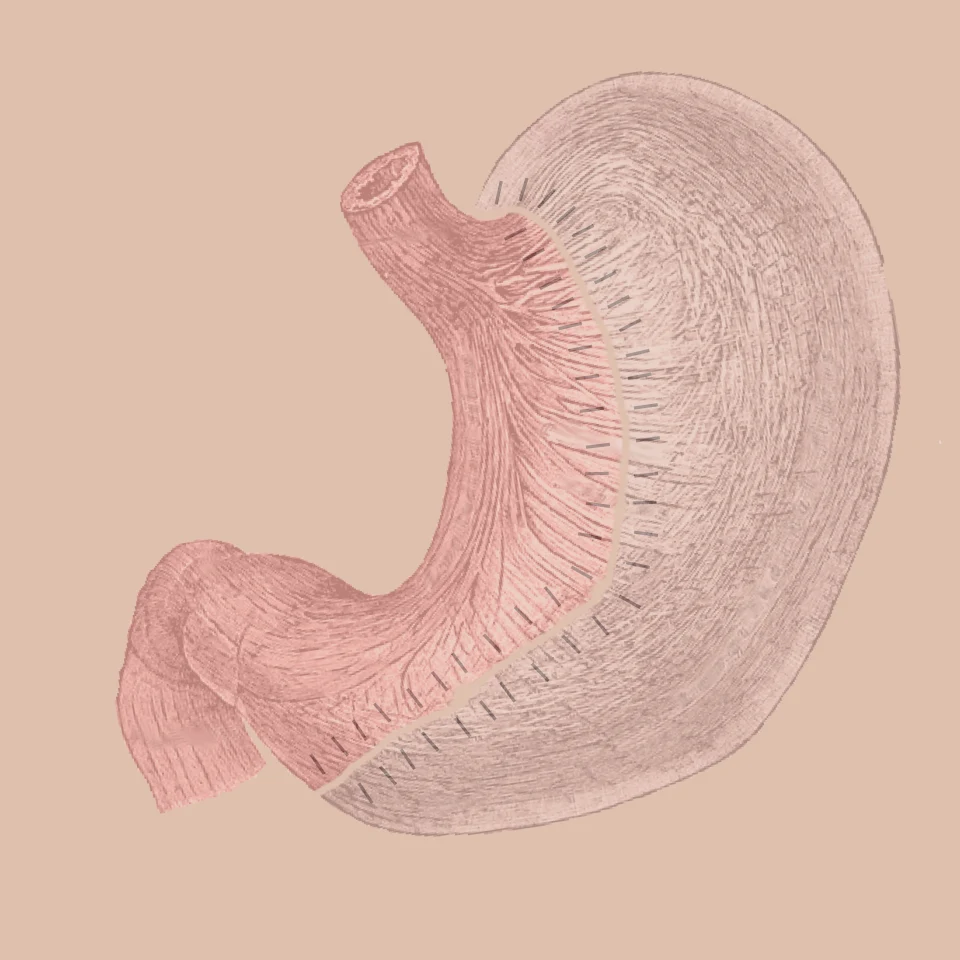
Sleeve gastrectomy changes the stomach into a narrow tube; this is a procedure schematic.
An educational schematic, not a patient result or a personalized treatment plan. Original labels may be in another language.
Open larger image ↗Source & licence
Kwipédl Cyop
Sleeve gastrectomy diagram (according IFSO and French HAS).svg · CC BY-SA 4.0
Simplified educational image; not to scale.
01How long does weight loss continue? Could I lose too much weight?
Most weight loss usually occurs in the first 1–2 years, but the pace and final weight vary from person to person. Reaching a BMI of exactly 25 is not guaranteed. Excessive weight loss, nutritional deficiencies or weakness require assessment; regular follow-up and nutritional review are part of treatment.
02How long does anaesthesia last during weight-loss surgery?
Sleeve gastrectomy and gastric bypass are performed under general anaesthesia. Its duration depends on the procedure, individual circumstances and any additional procedures, and includes preparation and waking up; it is not necessarily the same as the operating time. The anaesthetist will explain the estimated duration and recovery care before surgery.
03At what age can weight-loss surgery be performed?
Age alone does not determine suitability. In adults, overall health, the degree of obesity, associated conditions and ability to attend follow-up are assessed. There is no single upper age limit for everyone; older adults need more detailed assessment. For adolescents, decisions require a specialist team and specific criteria. A general age range such as 8–65 is not appropriate for everyone.
04Do shisha, cigarettes and nicotine affect sleeve surgery?
Yes. Smoking increases the risk of wound-healing problems, respiratory complications and blood clots. Start stopping as early as possible before surgery and agree the required period with your surgeon and anaesthetist. Advice to continue smoking until one week before surgery is not appropriate. Staying smoke-free after surgery also matters; tell the clinical team about all nicotine use.
05How does weight-loss surgery affect type 2 diabetes, high blood pressure, abnormal blood lipids and fatty liver?
These conditions may improve after metabolic surgery, and some people may achieve remission; results and timing differ. Stopping medication is not guaranteed. Diabetes and blood-pressure medicines must be adjusted with monitoring and medical advice; do not stop them yourself.
06How much pain is there after weight-loss surgery?
Abdominal or incision-site pain may occur after laparoscopy and is usually managed with the clinical team’s pain-relief plan. Pain varies between individuals. Severe or increasing pain, particularly with fever, breathlessness or a racing heart, needs urgent assessment.
07Can nausea and vomiting occur after sleeve gastrectomy or bypass?
Yes, either procedure can be followed by nausea or vomiting. Causes may include medication, eating too quickly, dehydration or a complication requiring assessment. Tell the clinical team immediately about persistent vomiting, inability to drink fluids, or vomiting with severe pain, fever or a racing heart.
08How many days will I stay in hospital after sleeve surgery?
A hospital stay after weight-loss surgery is usually 1–3 days; medical circumstances or recovery may require longer. Discharge follows assessment by the clinical team. Hospital stay, time spent in the city and when flying is permitted are not necessarily the same and should be arranged separately.
09If I tend to gain weight or have a history of weight gain, is gastric plication or sleeve surgery suitable?
Weight alone or family history is not enough to decide on surgery. Height, BMI, associated conditions, previous treatments and nutritional status must be assessed. For a small amount of excess weight, non-surgical treatments are usually considered first. Choosing gastric plication or sleeve surgery requires an examination and full assessment.